From 14 hours to 4 seconds: removing the human from the handoff
High-ticket property buyers were waiting most of a day for a call back. The routing that got every enquiry to the right agent's phone in seconds.
By Abdul Haseeb
Picture someone about to spend hundreds of thousands on a property. They find a listing they like, fill in the enquiry form, and hit send.
Then nothing happens. For fourteen hours.
By the time an agent calls, the buyer has already spoken to two other agencies, booked a viewing somewhere else, and mentally moved on. The ad click that brought them in was paid for. The lead was real. And it was lost in the most avoidable way possible: nobody picked it up in time.
That was the average response time at a real estate business I worked with. After I rebuilt the handoff, it was about 4 seconds.
Why speed matters more than almost anything else
"Respond faster" sounds like obvious advice, so it is worth saying why it matters so much.
A Harvard Business Review study of online leads ("The Short Life of Online Sales Leads", 2011) found that companies that tried to contact a lead within an hour were nearly seven times as likely to qualify it as companies that waited even an hour longer. The average response time across the companies studied was well over a day.
High-ticket buyers make this worse, not better. They shop around. They enquire with several agencies at once. The first credible human to call back has a huge advantage, and it has very little to do with who has the best listing.
In practice, speed to lead is one of the highest leverage levers in the whole funnel. You have already paid for the click. You already have the enquiry. Everything that happens after that is either conversion or waste.
Where the fourteen hours came from
Nobody was lazy. The process was the problem.
Enquiries landed in a shared inbox. Someone had to notice the email, open it, work out which property and which area it related to, figure out which agent covered that, and forward it on. That agent then had to see the forward and call.
Every step depended on a person being at a desk and looking at the right screen at the right time. Evenings and weekends, which is exactly when people browse property, were the worst. Response time was not set by the agents' skill. It was set by whoever happened to check the inbox.
- 01Form submitted
- 02Shared inboxWaits until someone looks
- 03Someone opens itWhen they are at a desk
- 04Works out property and area
- 05Forwards to the agentWho also has to notice
- 06Agent calls back
Average time to first response: 14 hours.
The fix: take the human out of the middle
The goal was not to replace agents. It was to remove every step between the form and the agent who could actually sell.
I wrote the routing myself, in four stages:
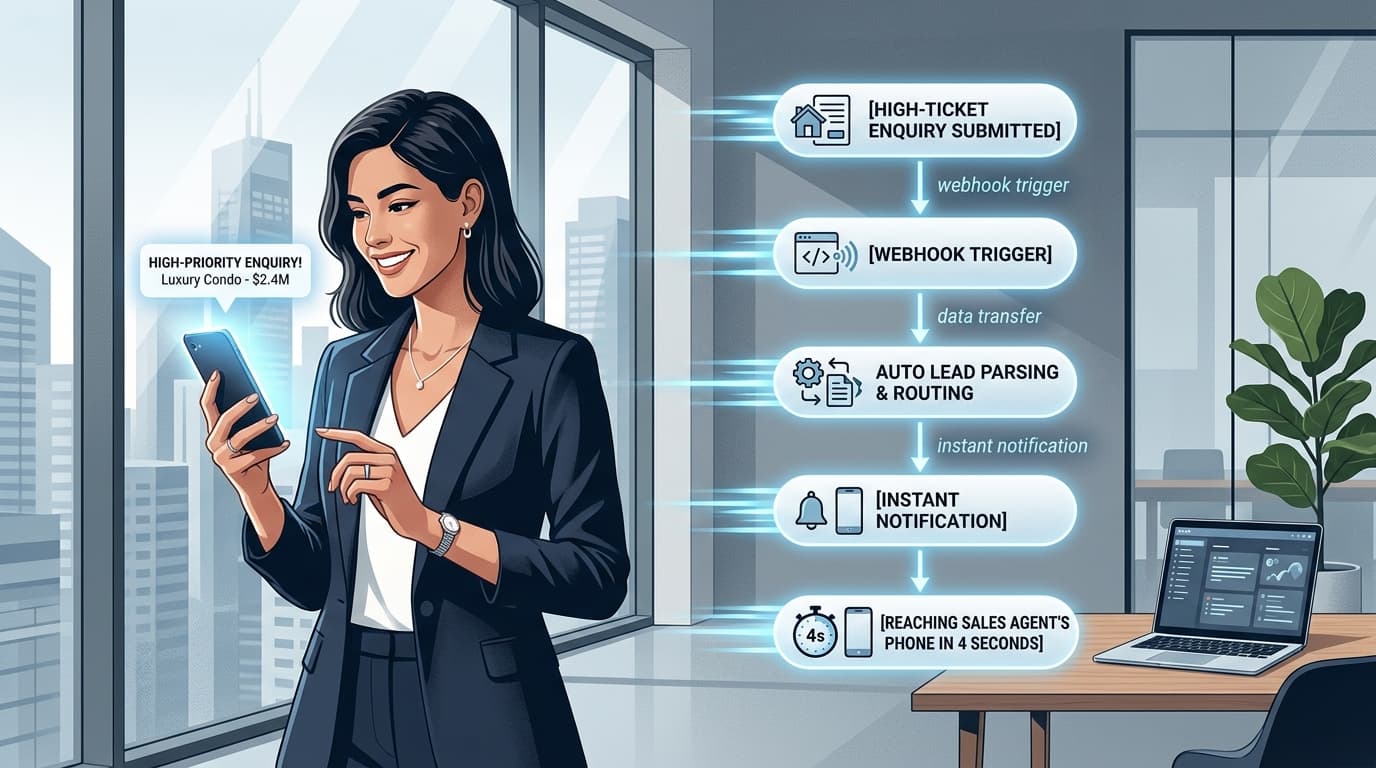
- Form submission to webhook. The moment an enquiry is submitted, the form sends it straight to a webhook, an automatic message one system sends another the moment something happens. No inbox involved.
- Payload parsing. A Google Apps Script receives the enquiry and pulls out what matters: the property, the area, the budget, and the contact details.
- Routing rules. Rules decide which agent owns that enquiry, with a fallback so nothing is ever left unassigned.
- Dispatch. The enquiry is pushed straight to that agent's phone by SMS, and posted to Slack so the team can see what is coming in and who has it.
- 01Form submissionWebhook fires instantly
- 02Payload parsingGoogle Apps Script
- 03Routing rulesWith a fallback agent
- 04DispatchSMS + Slack
About 4 seconds end to end.
The whole chain runs in seconds. The agent often sees the enquiry while the buyer is still looking at the thank you page.
Why I built it instead of buying a tool
Off-the-shelf lead routing tools exist. They tend to be priced per seat, opinionated about how routing rules work, or tied to a CRM migration nobody has time for.
A small custom version runs on tools a business usually already has, costs very little to run, and can be changed in minutes when the team changes. That trade-off, building small things that fit exactly instead of buying big things that nearly fit, is one I keep making. It is also why I built CrewSpace.
What to take from this
If you run paid acquisition for anything high-ticket, measure your actual speed to lead. Not what the team believes it is: the timestamp of the enquiry against the timestamp of the first real contact. The number is usually worse than anyone expects.
Then look at every step between the two and ask which ones need a human. Usually it is only the last one.
Speed is only half of it, though. If the landing page is slow, the enquiry never happens, which is why I rebuild landing pages instead of assembling them. And if the leads coming in are the wrong people, answering them faster does not help, which is where grading leads for Smart Bidding comes in.
The short version of this case, with the data path, is in the case studies. And yes, the irony is noted: if you send me a message, I reply fast.