Rebuilding landing pages instead of assembling them
Mobile visitors were leaving before the page loaded. Why I stopped waiting on page builders and developers, and wrote the pages myself.
By Abdul Haseeb
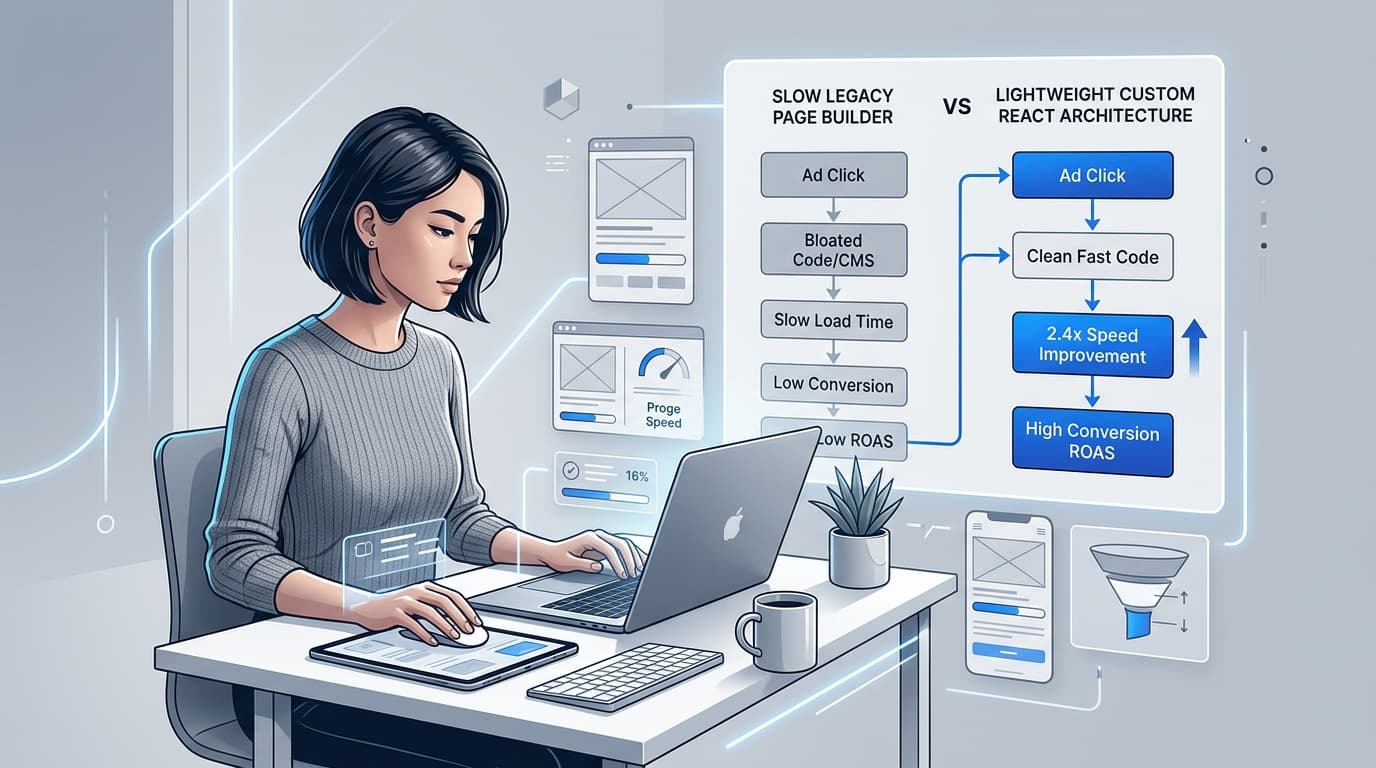
This is the story of how a paid media manager ended up writing React. It was not a career plan. It was mild frustration that got out of hand.
At EverLighten, a custom manufacturing e-commerce business, I was running paid campaigns that looked like they had a targeting problem. Mobile traffic was arriving and leaving almost immediately. The obvious move was to rework audiences, test new creative, and tighten keywords.
None of that was the problem. The page was.
After I rebuilt the landing pages myself, they loaded 2.4x faster, and the campaigns sustained a 5x ROAS.
The problem nobody on the marketing side looks at
Here is what a paid click actually costs you if the page is slow: the full price of the click, and nothing in return.
Google's own research found that more than half of mobile visits are abandoned if a page takes longer than three seconds to load. You never see those people in your analytics as "bounced after reading". Many of them never get far enough to be counted at all. In the ad account they just look like clicks that did not convert, which looks exactly like bad targeting.
Page speed also feeds back into the ad auction. Landing page experience is part of how Google judges ad quality, so a slow page can quietly make every click more expensive as well as less likely to convert.
Why the pages were slow
The pages were built in a drag-and-drop builder. Builders are great for getting something live quickly without a developer. The cost is that every page ships with the builder's entire toolkit: scripts for sliders nobody used, animation libraries, font files, tracking snippets from tools that were cancelled years earlier.
The page a visitor saw was simple. The page their phone had to download was not. Hundreds of kilobytes of code that nobody needed had to load before anything useful appeared.
- 01Ad clickPaid in full
- 02Builder page loadsSliders, animations, old tracking
- 03Visitor waitsMany leave here
- 04ConversionFor whoever is left
The traditional fix is to ask the development team to build proper pages. Which works, eventually, once the request reaches the top of a queue shared with everything else the business needs. Paid campaigns do not wait politely while that happens. Every week the slow page stays live, the budget pays for it.
What I built instead
I taught myself enough React to build the pages directly.
- Static pages. Each landing page is generated ahead of time as plain HTML, so there is nothing to assemble in the browser before the visitor sees content.
- Served from an edge CDN. The files sit on servers close to the visitor, so the first byte arrives quickly wherever they are.
- Only what the page needs. No builder toolkit. One font, the images the page actually shows (properly sized for mobile), and the tracking that matters.
- Built and shipped by the person running the campaign. This is the part that mattered most. When a test needed a new headline or layout, it went live the same day, not the next sprint.
The conversion event at the end of the page stayed exactly as reliable as before, so we could measure the change cleanly.
- 01Ad clickSame campaigns
- 02Edge CDNServed close to the visitor
- 03Static renderReact, built ahead of time
- 04Conversion eventUnchanged, measured cleanly
What changed
The pages loaded 2.4x faster. More of the mobile visitors we were already paying for stayed long enough to read, and more of them converted. ROAS held at 5x across the campaigns.
The targeting that "needed fixing" was fine all along.
What I would tell another marketer
You do not need to become a developer. But it is worth being able to answer one question yourself: how long does my landing page take to become usable on a normal phone on a normal mobile connection? Google's PageSpeed Insights will tell you in about thirty seconds, for free.
If the answer is "a while", that is almost certainly the cheapest conversion rate improvement available to you. Most teams hand it to whoever is least busy, which in my experience is nobody.
A fast page is only the start of the post-click journey. What happens after the form is submitted matters just as much, and I wrote about that in going from 14 hours to 4 seconds. And if the conversion that page produces never reaches the ad platform, the algorithm cannot learn from it: that is moving the conversion path out of the browser.
The short version of this case is in the case studies, and the career context is in Chapter III on the homepage. If your campaigns look like they have a targeting problem, let's talk. Sometimes it is the page.